0:20
Stairs · trial 1
Clean perception
CoRL 2026 · Humanoid locomotion


Conference on Robot Learning (CoRL) 2026
One policy. Continuous adaptation through perception loss and recovery.
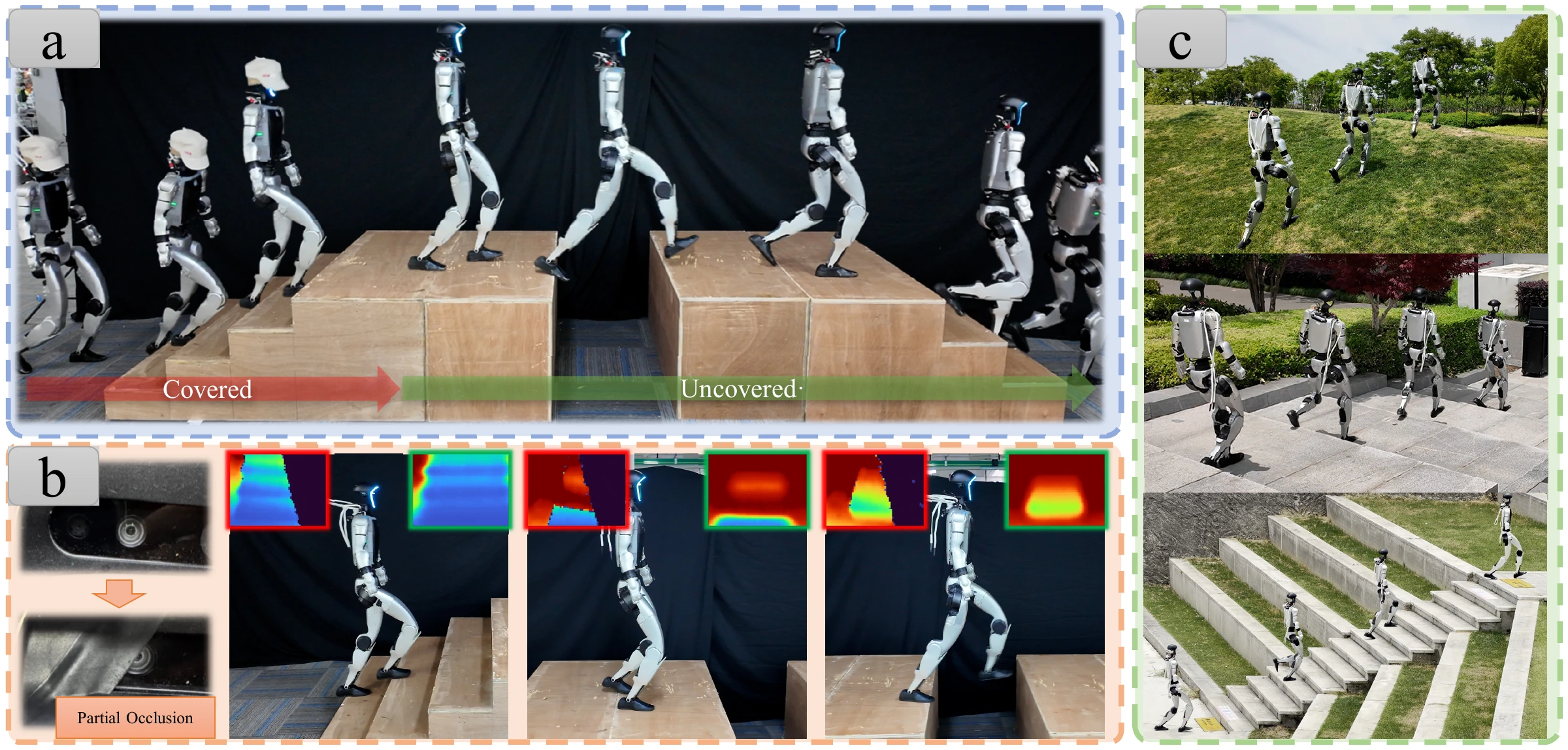
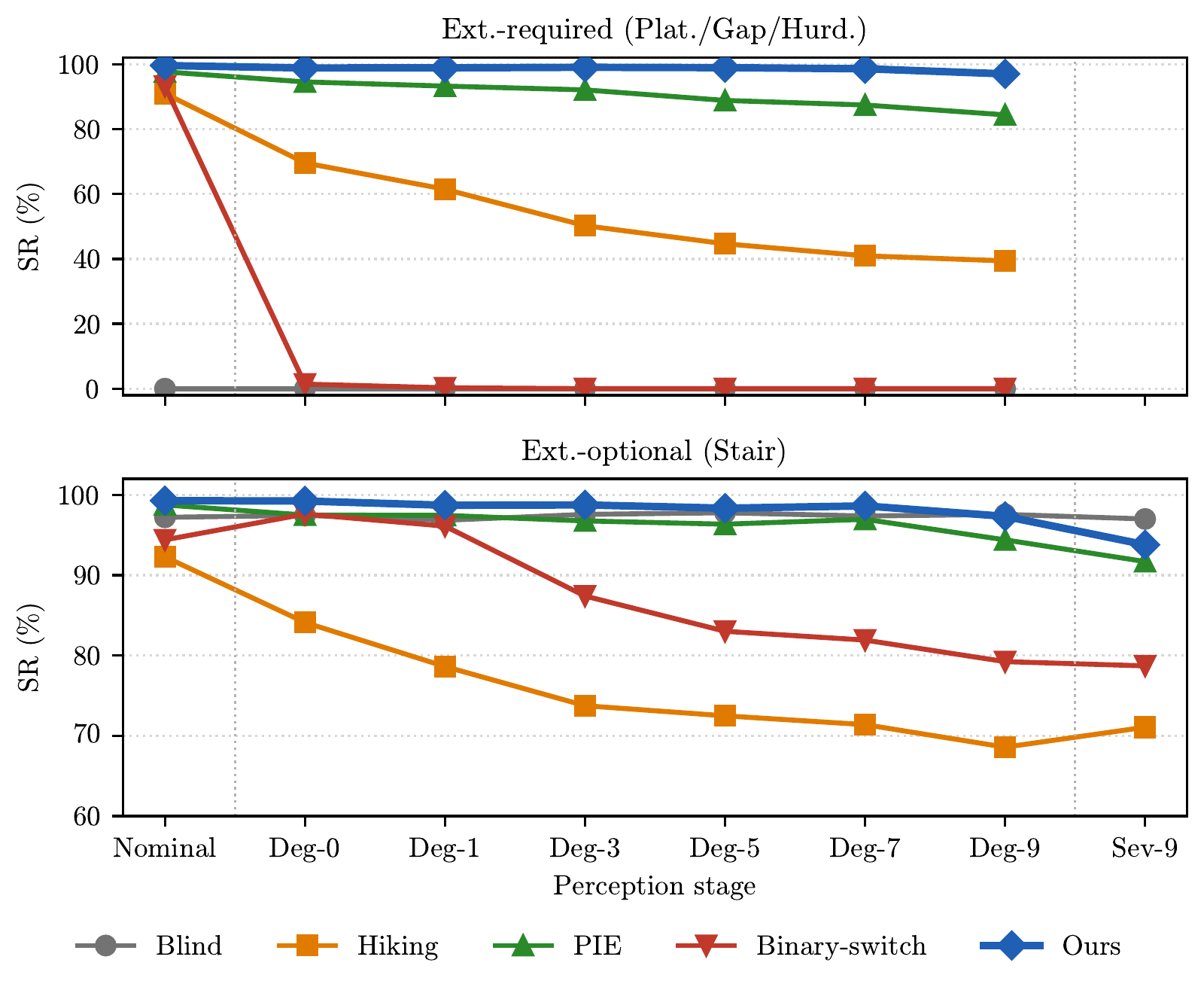
Humanoid locomotion across complex terrain demands forward-looking exteroception to anticipate obstacles, yet this signal is unreliable in real-world deployment, failing partially and intermittently. Existing perceptive policies often assume that depth observations remain clean and in-distribution, while recent attempts to unify perceptive and blind control typically route or switch between separate sub-policies, leaving recoverable information in partially corrupted depth unexploited. We instead propose CAP, a single-stage humanoid locomotion policy that recovers this signal with a perceptive world-model encoder trained as a learned denoiser to reconstruct clean depth from a corrupted input, together with a co-active proprioceptive variational encoder that supplies depth-free body-state information. A coupled training recipe pairs a depth-noise curriculum on the world-model input with world-model feature dropout on the policy-facing latent, exposing the policy to failures across the entire perception-quality spectrum. In simulation, CAP matches or improves upon perceptive baselines when depth remains informative, and degrades more smoothly than a binary-switching baseline as perception worsens. On the Unitree G1, controlled trials and indoor–outdoor deployments demonstrate perception-robust locomotion under intermittent occlusion, real-sensor corruption, and outdoor depth artifacts.
On the real robot
Perception-robust locomotion on the Unitree G1.
Stairs and mixed terrain under normal sensing.
Partial occlusion, complete camera cover, and changing perception.
Grass slopes, long staircases, platforms, and more outdoor stair views.
The method
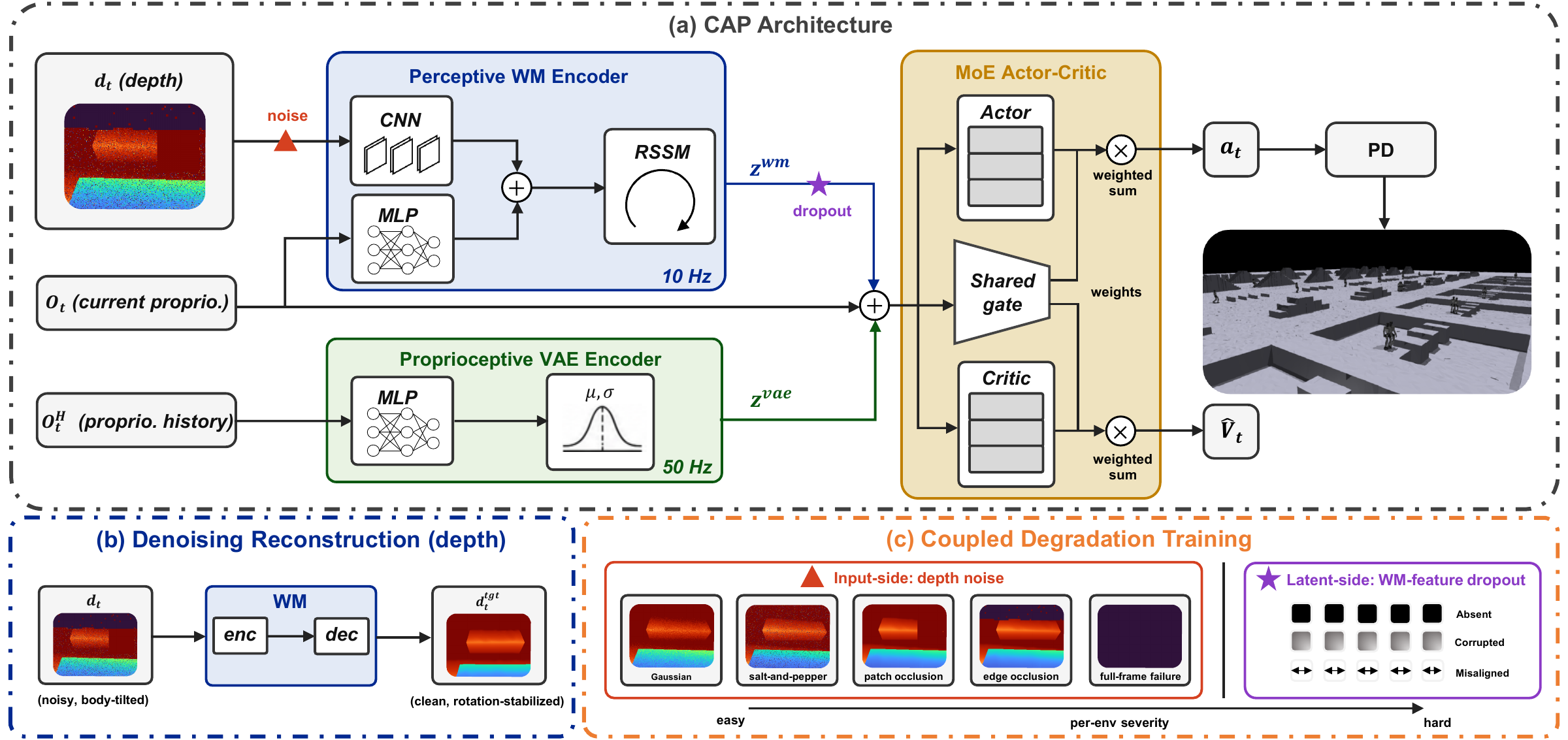
A denoising perceptive pathway and a depth-free proprioceptive pathway remain co-active.
 View full resolution
 The world model reconstructs a clean, stabilized depth target from corrupted observations, learning to recover useful terrain structure.
A high-rate proprioceptive VAE supplies depth-free body-state information alongside the perceptive pathway.
A depth-noise curriculum and world-model feature dropout expose the policy to both input corruption and unreliable perceptive features.
Evidence from the paper
Simulation sweeps and controlled hardware trials evaluate changing perception quality.
Controlled real-world trials
successful trials under clean
and partially occluded perception
| Perception | Stair | Platform | Gap | Mixed |
|---|---|---|---|---|
| Clean | 5/5 | 5/5 | 5/5 | 5/5 |
| Partial occlusion | 5/5 | 4/5 | 5/5 | 5/5 |
| Full cover | 5/5 | 0/5 | 0/5 | 0/5 |
Complete perception loss remains a limitation on terrain that requires forward-looking depth, such as gaps and platforms.
All experiments in the complete project video.
Read the paper
Architecture, training, evaluations, and limitations.
Reference
@inproceedings{chen2026cap,
  title = {{CAP}: Continuously Adaptive Perception-Blind Humanoid Locomotion via Learned Denoising},
  author = {Chen, Hongjin and Xu, Zijun and Ma, Shihao and Zhao, Yi and Liu, Xilai and Ma, Ke and Zhang, Wei and Xie, Chunyang and Li, Pengfei and Zhao, Jieru and Ding, Wenchao},
  booktitle = {Conference on Robot Learning},
  year = {2026},
  eprint = {2609.11553},
  archivePrefix = {arXiv},
  primaryClass = {cs.RO},
  url = {https://arxiv.org/abs/2609.11553}
}